Leave Your Message

Why Do Compressors Need Coolers?

Why Do Compressors Need Coolers?

Compression creates heat. A lot of it.

When air or gas is squeezed inside a compressor, its temperature rises quickly. Discharge pipes may become dangerously hot, while oil loses viscosity and lubricating performance. A properly selected Compressors Cooler removes this excess heat before it damages seals, valves, bearings, or downstream equipment.

Dr. Heinz P. Bloch, a widely published rotating-equipment engineer, expresses the principle clearly: “A compressor’s reliability is often decided by how well its heat is controlled.” His observation reflects practical maintenance experience. Intercoolers reduce heat between compression stages. Aftercoolers lower the final discharge temperature. Oil coolers protect the lubrication circuit during long operating cycles. Each cooler performs a different job.

The details matter.

Cooling water quality, airflow, fin cleanliness, and pressure drop can change performance. A cooler that looks adequate on paper may struggle in a dusty factory or during summer operation. Condensation can also appear when compressed air cools. Without proper drainage, that moisture may travel into filters, pipelines, and production equipment.

The solution is not simply “add more cooling.” Oversized equipment can increase cost, footprint, and energy use. Undersized equipment can create hidden thermal stress. Engineers must examine flow rate, inlet temperature, ambient conditions, oil type, and duty cycle together.

This topic deserves some humility. A cooler cannot repair poor maintenance or incorrect system design. However, the right Compressors Cooler can stabilize temperature, improve efficiency, and extend service life. That small heat exchanger may quietly determine whether a compressor runs smoothly—or stops at the worst possible moment.
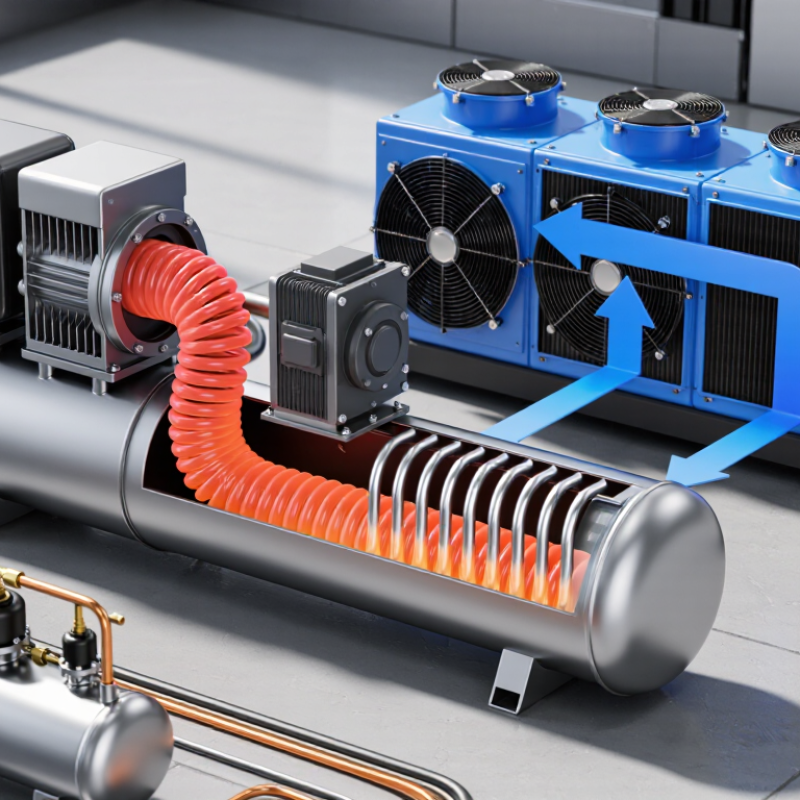
Why Do Compressors Need Coolers?

Compression Heat: Why Air Temperatures Can Exceed 150°C

Why Do Compressors Need Coolers?

Compression Heat: Why Air Temperatures Can Exceed 150°C

When a compressor squeezes air into a smaller space, mechanical work becomes heat. The discharge temperature can exceed 150°C, especially with high pressure ratios, warm intake air, or poor compression efficiency. The metal gets hot. This is not a minor comfort issue. Excessive heat can damage seals, thin lubricating oil, and shorten valve life.

Coolers remove heat between compression stages or after discharge. An intercooler lowers the air temperature before the next stage, reducing the work required for further compression. An aftercooler treats the final compressed air before it enters storage or production equipment. Cooler air also releases moisture, which may collect as liquid inside pipes. That detail is easy to overlook.

In real operation, temperature readings are rarely perfect. Sensor position, airflow, dust, and maintenance condition can change the result. A discharge reading below 150°C does not automatically prove safe operation. Pressure, temperature, oil condition, and cooler cleanliness should be checked together. My practical preference is to compare readings over time, not trust one measurement. A small upward trend may reveal fouling before a serious failure.

Tips: Keep cooler fins clean and maintain clear airflow. Check condensate drains regularly. Record inlet and outlet temperatures during normal loads. If temperatures rise unexpectedly, inspect filters, valves, ventilation, and sensor accuracy before increasing operating pressure.
Intercoolers Reduce Multistage Compression Work by About 5–10%

Why Do Compressors Need Coolers?

Intercoolers reduce multistage compression work by about 5–10% in many practical installations. The saving comes from cooling air between compression stages. Cooler air occupies less volume and requires less work for the next stage. The ideal calculation assumes near-perfect intercooling, but real systems lose some benefit through pressure drop, fouling, and imperfect heat transfer.

The Compressed Air & Gas Handbook explains that multistage compression with intercooling can approach the lower work of near-isothermal compression. Guidance from the U.S. Department of Energy also identifies intercooling as a key method for controlling discharge temperature and improving compressor efficiency. A 5–10% reduction is therefore a useful engineering reference, not a guaranteed result. Small details matter.

During a site inspection, technicians should check cooler outlet temperature, condensate drainage, airflow, and pressure loss. A blocked fin pack can turn a theoretical saving into a maintenance problem. Water-cooled units may perform differently from air-cooled units, especially during summer operation. The U.S. Energy Information Administration reports that industrial facilities often use compressed air continuously, making small efficiency losses financially significant over time. Yet the calculation can be misleading if control settings change. Measure power before and after cooling improvements. Real operating data deserves more trust than a catalog estimate.

Aftercoolers Lower Discharge Air to Within 10–15°F of Ambient

Why Do Compressors Need Coolers?

Compressed air leaves the compressor extremely hot, often far above the surrounding room. An aftercooler removes much of that heat before air enters the receiver, piping, or pneumatic equipment. A properly selected unit can lower discharge air to within 10–15°F of ambient temperature. That target matters. If the room is 80°F, the outlet may be roughly 90–95°F under stable conditions. Cooler air reduces thermal stress and makes moisture control more predictable.

Hot compressed air carries water vapor. As it cools, vapor condenses into liquid water. An aftercooler therefore needs a reliable separator and drain, not just a fan and metal core. In service work, technicians should check inlet temperature, airflow, pressure drop, and drain operation. A blocked core or dirty fins can push outlet temperature well beyond the expected range. The numbers tell the story. Measure them at operating load, not only during a short test.

The 10–15°F figure is a practical design goal, not a promise in every environment. High humidity, poor ventilation, undersized cooling capacity, and changing production loads can alter results. I have seen readings look acceptable at startup, then climb after an hour. That detail is easy to miss. Regular cleaning and inspection help, although maintenance schedules should follow actual conditions. A cooler cannot fix a compressor room that is already starved of fresh air.

Why Do Compressors Need Coolers? - Aftercoolers Lower Discharge Air to Within 10–15°F of Ambient

Data Dimension Typical Value or Range Why It Matters
Ambient air temperature 70–95°F (21–35°C) The reference temperature used to evaluate aftercooler performance.
Air temperature leaving the compressor Approximately 250–400°F (121–204°C), depending on pressure ratio and compressor design High discharge temperatures can damage equipment, degrade lubricants, and increase moisture condensation downstream.
Aftercooler outlet temperature Typically within 10–15°F (5.5–8.3°C) of ambient air temperature Lower outlet temperature improves air-treatment performance and helps protect downstream components.
Example ambient temperature 80°F (26.7°C) A representative condition for illustrating expected aftercooler outlet performance.
Example aftercooler outlet temperature 90–95°F (32.2–35°C) This represents an approach temperature of approximately 10–15°F above ambient.
Condensate formation Common when compressed air is cooled below its dew point Cooling allows water vapor to condense so it can be removed by a moisture separator and drain.
Typical moisture-removal location Immediately downstream of the aftercooler Removing liquid water before storage and distribution reduces corrosion and liquid carryover.
Cooling medium Ambient air or cooling water Air-cooled units use fans and finned surfaces; water-cooled units transfer heat through a heat exchanger.
Pressure drop through the cooler Commonly about 1–3 psi (0.07–0.21 bar), depending on design and flow Excessive pressure drop reduces usable system pressure and can increase compressor energy demand.
Key maintenance tasks Clean heat-transfer surfaces, inspect drains, check separators, and verify airflow or water flow Blocked fins, fouled passages, or failed drains can raise outlet temperature and allow moisture into the system.
Primary system benefits Lower temperature, reduced moisture, improved air quality, and better equipment protection A properly sized and maintained aftercooler supports reliable operation of dryers, filters, valves, tools, and pneumatic controls.

Note: Actual temperatures and pressure drops vary with compressor type, operating pressure, flow rate, cooling-medium temperature, and maintenance condition.

Cooling Removes Condensation, Oil, and Corrosion Risks

Why Do Compressors Need Coolers?

Cooling Removes Condensation, Oil, and Corrosion Risks

Compressed air leaves a compressor hot, often carrying moisture and traces of oil. As the air cools inside pipes, water vapor becomes liquid. That change is easy to miss. A small drain can collect surprising amounts of water during a humid shift. If this condensate travels downstream, it can damage valves, contaminate instruments, and weaken product quality. In my experience, operators often notice the problem only after rust stains appear.

An aftercooler lowers air temperature before storage or distribution. It works with separators and automatic drains to remove much of the condensed water. The result is cleaner air and less liquid inside receivers, hoses, and filters. Cooling also helps control oil carryover. Warm oil moves easily through the system, while cooler air allows separators to capture more droplets. Performance still depends on correct sizing, airflow, and drain maintenance. A neglected drain can turn good equipment into a wet trap.

Corrosion is the longer-term risk. Moisture and oxygen attack steel surfaces, especially at low points and threaded connections. Regular temperature checks, drain tests, and receiver inspections provide useful evidence. Dew point measurement may reveal hidden moisture that visual checks miss. No cooler solves every air-quality problem. I would not treat it as a set-and-forget device. Ambient humidity changes, and maintenance habits vary. Even a well-designed system can fail quietly when one drain sticks.

Stable Temperatures Protect Lubricants, Seals, and Downstream Equipment

Why Do Compressors Need Coolers?

Stable Temperatures Protect Lubricants, Seals, and Downstream Equipment

Compression creates heat quickly, especially during long duty cycles or high-pressure operation. A cooler removes this heat before it damages the system.

Hot lubricant loses viscosity and cannot form a dependable protective film. Metal contact then increases, while oxidation creates sludge and weakens oil performance. The result is rarely immediate. Wear accumulates quietly. Seals face similar stress. Excessive temperature hardens elastomers, changes clearances, and can cause early leakage.

In oil-flooded compressors, an oil cooler helps maintain a controlled injection temperature. In compressed-air systems, an aftercooler lowers discharge temperature and condenses moisture before air reaches piping or tools. Drainage still matters. Water left in lines can promote corrosion and disrupt instruments.

Technicians should check cooler fins, airflow, coolant condition, and temperature readings during routine service. A dirty surface can look harmless but reduce heat transfer sharply. Measuring inlet and outlet temperatures provides better evidence than touch alone. A cooler is not a cure-all. Poor sizing can waste energy, while an undersized unit leaves temperatures unstable. Actual load data should guide adjustments.