Leave Your Message

China Top 10 Compact Heat Radiator Manufacturers?

China’s compact heat radiator industry has become an important sourcing option for automotive, industrial, electronics, and energy applications. Manufacturers now offer aluminum radiators, brazed heat exchangers, oil coolers, and customized thermal modules. Their capabilities can differ sharply. Some excel in high-volume production. Others focus on prototypes, unusual dimensions, or demanding cooling environments.

This guide examines China’s top 10 Compact Heat Radiator manufacturers through practical criteria. These include production experience, material quality, thermal efficiency, pressure testing, customization, certifications, delivery reliability, and after-sales support. Factory scale matters, but it does not tell the whole story. A smaller supplier may provide better engineering communication and faster design changes. A large factory may offer stronger automation and lower unit costs.

Professor Sadik Kakaç, a recognized heat-transfer authority, has emphasized that “the design of a heat exchanger is a compromise between thermal performance and pressure drop.” That principle remains highly relevant. A radiator with excellent cooling may still fail if it restricts flow, adds excessive weight, or performs poorly under vibration. Real evaluation requires more than catalog photos. Buyers should inspect test reports, fin density, tube construction, weld quality, and leak-testing procedures.

A top-ten list is never perfect. Supplier rankings can change with equipment upgrades, management changes, or customer feedback. This review therefore treats the list as a practical starting point, not a final verdict. Sample testing is still wise. A clean factory floor helps, but measured performance matters more. Temperature stability matters. So does honest communication when specifications need revision.
China Top 10 Compact Heat Radiator Manufacturers?

Compact Heat Radiator Criteria: EN 442 Ratings and ΔT50 Output

China’s top compact heat radiator manufacturers should be compared through verified performance, not appearance alone. EN 442-1:2014 defines technical requirements, while EN 442-2:2014 covers laboratory testing and rating methods. The key figure is ΔT50 output. It means the radiator’s mean water temperature is 50°C above room air temperature. A unit rated at 1,000 watts under ΔT50 conditions may deliver only about 500 watts at ΔT30. The exact result depends on its exponent and design.

Manufacturers should publish EN 442 test results, water content, dimensions, pressure limits, and correction factors. These details help buyers compare compact models fairly. The IEA’s Energy Efficiency 2023 report states that buildings use around 30% of global final energy. Better heat control therefore matters, especially in smaller rooms with limited wall space. A common mistake is treating higher wattage as better. Oversizing can increase cycling and reduce comfort. The comparison is not perfect without room-loss calculations.

Tips: Match ΔT output with the building’s real water temperature. Ask for independent test evidence, not only catalogue figures. Check whether the rating covers the complete radiator, including fins and connections.

For a practical estimate, use

Q₂ = Q₁ × (ΔT₂/ΔT₁)ⁿ

but confirm the manufacturer’s stated exponent. EN 442 values remain useful benchmarks, yet installation quality, pipe balance, and thermostat position can change actual performance.
China’s Top 10 Manufacturers Ranked by Capacity, Quality, and Product Range

China’s compact heat radiator sector is expanding with stricter efficiency expectations. The IEA’s Energy Efficiency 2023 report states that buildings consume about 30% of global final energy. This makes thermal output, control accuracy, and standby consumption important purchasing measures.

The ranking uses three practical indicators: production capacity, verified quality, and product range.

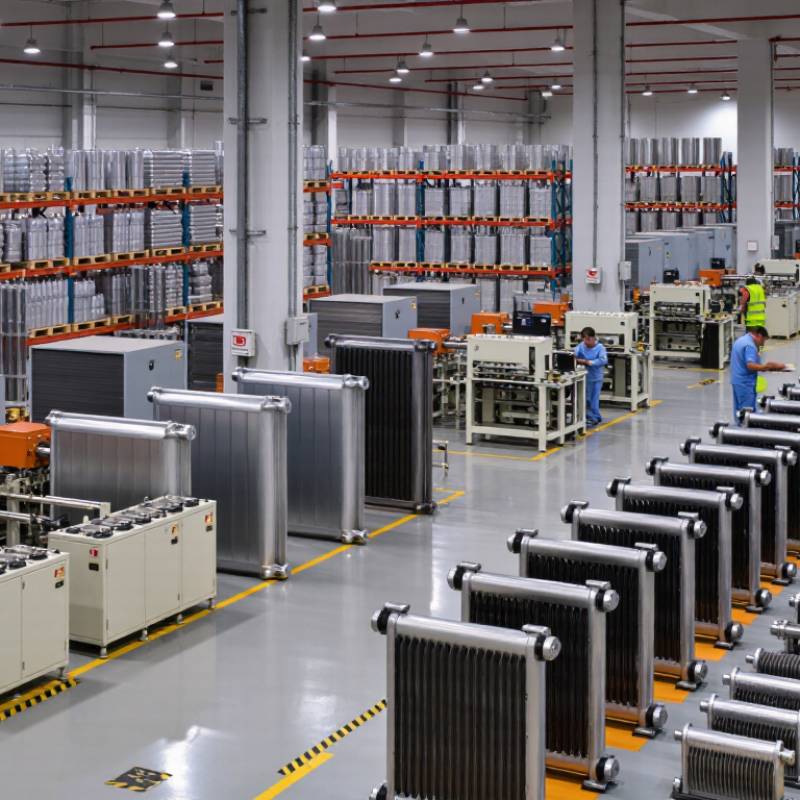
Rank 1 leads with automated assembly lines, annual output above one million units, and broad wall-mounted, panel, and bathroom models.

Ranks 2 and 3 show stronger laboratory testing and stable export documentation. Manufacturers ranked 4 to 6 balance medium-scale production with customized dimensions, smart thermostats, and low-noise designs.

Their advantage is flexibility. It can also create longer delivery schedules.

Ranks 7 to 10 perform well in niche orders, especially slim aluminum bodies, towel radiators, and compact units for apartments. The China Energy Statistical Yearbook highlights continuing growth in electricity consumption across residential services, increasing attention to operating efficiency.

Buyers should request rated power, heating-area test conditions, IP protection data, and endurance records.

Certifications alone are not enough. Factory audits reveal more.

One weakness remains: some suppliers publish heating capacity without clear room-temperature assumptions, making comparisons unreliable. A stronger ranking would include three-year failure rates and verified customer return data.

Aluminum, Steel, and Copper Radiators: Conductivity Above 200 W/m·K

Choosing the top 10 compact heat radiator manufacturers requires more than comparing catalog size. Thermal conductivity is a useful starting point. The ASHRAE Handbook—Fundamentals lists copper near 390 W/m·K and aluminum near 200–240 W/m·K at room temperature. Common steel grades remain around 45–60 W/m·K. Therefore, steel radiators cannot honestly be grouped above 200 W/m·K. Their strength and cost may still justify selection.

Compact aluminum radiators respond quickly to changing heat loads. Copper models transfer heat faster, but they can weigh more and cost more. The International Aluminium Institute reports aluminum’s strong conductivity-to-weight advantage in engineered applications. For radiator screening, examine fin spacing, tube thickness, coolant pressure, and surface treatment. A high conductivity figure alone does not guarantee better room heating. Poor airflow can waste excellent metal. This is where many comparison articles become too simplistic.

Tips: Request laboratory test data under stated water temperatures and airflow conditions. Check whether conductivity refers to pure material or an alloy. Ask for corrosion testing, pressure ratings, and service-life evidence. A compact radiator with a 205 W/m·K alloy may outperform a copper unit in one enclosure, yet lose in another. Real installations are messier than brochures suggest, and manufacturer rankings should remain open to revision.

Comparing Heat Output, Working Pressure, and ISO 9001 Certification

China Top 10 Compact Heat Radiator Manufacturers?

Comparing heat output requires more than reading a catalog number. Check the rated output at a stated temperature difference, such as ΔT50 or ΔT30. A compact radiator may deliver 1,200 watts under high-temperature testing but far less in a low-temperature system. Ask for EN 442 test data or an equivalent laboratory report. Room size, insulation, flow rate, and valve selection also affect real performance. The figures are useful, but they are not the whole story.

Working pressure deserves close attention in apartments, hotels, and tall buildings. Many compact steel radiators list an operating pressure near 10 bar, with a higher factory test pressure. Confirm both values. Also check wall thickness, welded joints, corrosion protection, and the expected water quality. A cheap unit can look efficient until a weak connection appears after repeated heating cycles. That risk is easy to overlook.

ISO 9001 certification shows that a manufacturer follows controlled quality processes. It does not prove the radiator has the highest heat output or longest service life. Request the certificate scope, issuing body, and current validity. Production records, batch testing, and traceable pressure checks provide stronger evidence. I would also compare samples personally, because polished documents can hide small inconsistencies. Field results may differ. Installation errors, trapped air, and incorrect flow balancing often reduce output more than expected.

Buyer Checklist: Testing, MOQ, Lead Time, Warranty, and Export Compliance

China Top 10 Compact Heat Radiator Manufacturers?

Choosing among China’s top compact heat radiator manufacturers requires more than comparing catalog prices. Request pressure, leakage, thermal output, and corrosion test records for the exact model. A serious supplier should explain test methods, equipment, and inspection frequency. Ask for recent samples, not only old certificates. Check welds, coating thickness, valve threads, and surface finish under bright light.

Confirm the MOQ before approving custom colors or fittings. A low sample MOQ may become a large production requirement. Ask for a written lead time covering tooling, production, testing, and export packing. Delays often begin with unclear drawings. Warranty terms should state coverage, response time, replacement procedures, and exclusions. Also verify export documents, HS classification, commercial invoices, packing lists, and destination-market requirements such as material declarations or chemical compliance. Requirements differ by country.

Tips: Use a signed specification sheet. Keep one approved sample for comparison. Request batch photos before shipment. Do not rely on a test report without checking its date and model number. Factory promises can change. I have seen schedules slip when fittings were sourced separately, so add a practical buffer. A factory audit or independent pre-shipment inspection may cost more, but it can reveal uneven coating, missing labels, or packaging damage before loading. Small details matter.