Leave Your Message

What Is the Best Heat Exchanger Technology in China?

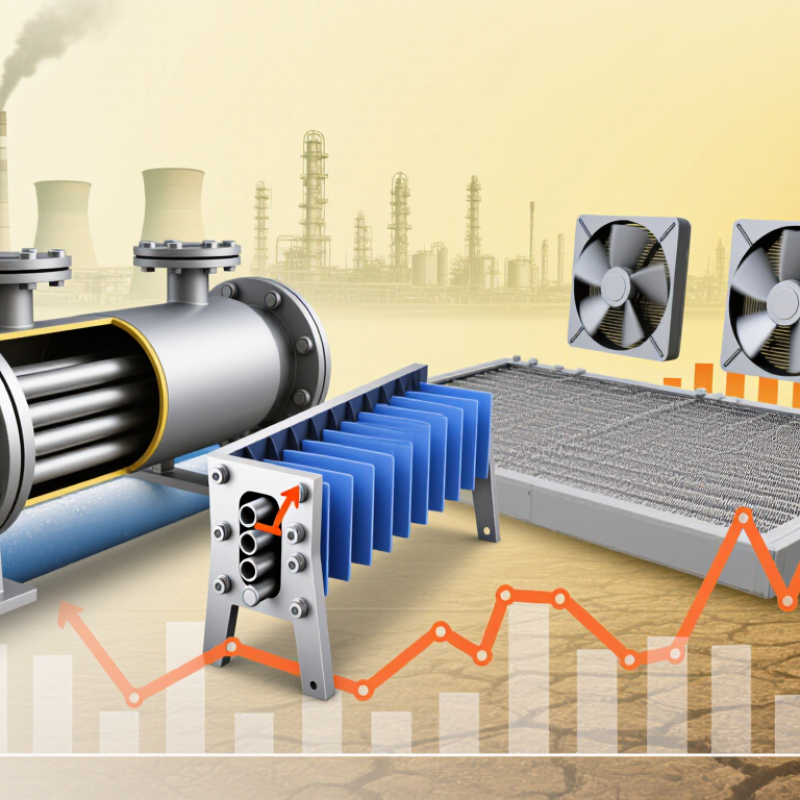
What Is the Best Heat Exchanger Technology in China? The answer depends on temperature, pressure, fluid cleanliness, footprint, and maintenance access. No single design wins every plant. Shell-and-tube units remain common in petrochemical, power, and chemical facilities because they tolerate high pressure and demanding fluids. Gasketed plate exchangers offer compact installation and strong heat recovery. Air-cooled exchangers can reduce water consumption in dry regions, but their performance may weaken during China’s hottest summer days.

Market evidence shows why this decision matters. Grand View Research estimated the global heat exchanger market at approximately USD 19.36 billion in 2023. It also forecast about 7.1% annual growth from 2024 to 2030. These figures indicate expanding demand, not one guaranteed technology leader. The International Energy Agency’s Energy Efficiency 2023 report continues to identify industry as a major energy consumer. Therefore, recovering even a few degrees of waste heat can influence operating costs. The result becomes visible in practice: warmer boiler feedwater, smaller cooling towers, and fewer hours of compressor operation.

China’s selection process should combine plant experience with recognized engineering requirements. Designers commonly review GB/T 151 for pressure vessels, TEMA practices, and applicable ASME or API guidance. Material choice also matters. Stainless steel may resist corrosive water, while titanium can suit seawater service, though its purchase price is higher. Fouling, vibration, cleaning frequency, and local fabrication capability must enter the calculation. A polished simulation can still miss uneven flow inside a real channel. For this reason, the best Heat Exchanger Technology in China is usually the one that balances thermal duty, lifecycle cost, safety, and maintainability. That conclusion may change after one year of operation. Performance data should decide.

What Is the Best Heat Exchanger Technology in China?

Heat Exchanger Technologies Commonly Used in China

China uses several heat exchanger technologies, selected by temperature, pressure, fluid quality, and available space.

Shell-and-tube exchangers remain common in chemical plants, power stations, refineries, and district heating systems. Their robust structure handles high pressure and dirty fluids. Technicians can also remove the tube bundle for inspection and cleaning.

Plate heat exchangers are widely used in food processing, building services, and central heating. Their corrugated plates create strong turbulence, improving heat transfer in a compact frame. However, narrow channels can clog when water contains sediment. Regular filtration matters.

Gasket aging is another practical concern, especially under frequent temperature changes. I have seen small leaks begin after poor tightening, not poor design.

Air-cooled heat exchangers suit areas where cooling water is limited. Large fans move ambient air across finned tubes, reducing water consumption. They need clear airflow and careful noise control.

Spiral exchangers can handle some difficult fluids while saving installation space, but maintenance access may be less convenient. Welded plate units offer compact performance for demanding duties, although repairs require more specialized work.

No option wins every project. Engineers should compare lifecycle cost, fouling risk, cleaning methods, local climate, and spare-part availability. A design that looks efficient on paper may perform poorly beside a dusty road or during winter startup.

How Different Heat Exchanger Designs Work

Choosing the best heat exchanger technology in China depends on how each design handles heat, pressure, fouling, and maintenance. The main options include shell-and-tube, plate, air-cooled, spiral, and compact printed-circuit exchangers. Shell-and-tube units use tubes inside a pressure-resistant shell. They suit high pressure, high temperature, and dirty fluids. Plate exchangers guide fluids through thin, corrugated plates. Their large contact area delivers strong heat transfer in a compact footprint. They can be less suitable when solids clog narrow passages.

Air-cooled exchangers reject process heat through finned tubes and fans. They reduce water demand, which matters in northern and inland Chinese facilities. However, summer air temperatures can reduce performance. Spiral exchangers create a single curved flow path, improving turbulence and limiting dead zones. Compact designs save space, but repairs may require specialized procedures. No design wins everywhere. That assumption often fails.

The International Energy Agency reports that industry consumed about 37% of global final energy in 2022, making recovery efficiency commercially important. The U.S. Department of Energy estimates that industrial heat recovery can reduce fuel use by roughly 10% to 20% in suitable processes. These figures support tighter exchanger selection, not automatic replacement. A plant assessment should compare approach temperature, pressure drop, fouling rate, cleaning access, water availability, and lifecycle cost. A slightly larger exchanger may perform better after three years of deposits. Real operating data matters more than catalogue efficiency. Sources: IEA, Energy Efficiency 2023; U.S. DOE, Waste Heat Recovery: Technology and Opportunities in U.S. Industry.

What Is the Best Heat Exchanger Technology in China? - How Different Heat Exchanger Designs Work

Heat Exchanger Design How It Works Typical Strengths Typical Limitations Common Pressure and Temperature Range* Typical Applications Best Selection Criteria
Shell-and-Tube One fluid flows through tubes while the other flows around the tubes inside a shell. Heat passes through the tube walls without mixing the fluids. Robust construction; suitable for high pressure and high temperature; handles many liquid, gas, and phase-change duties; easy to customize. Larger footprint; generally lower heat-transfer coefficient than plate designs; tube-side fouling may require mechanical cleaning. Commonly used from vacuum service to more than 100 bar, with temperatures ranging from cryogenic service to several hundred degrees Celsius, depending on materials and design. Power generation, oil and gas, chemical processing, steam condensation, reboilers, coolers, and high-temperature duties. Choose when pressure, temperature, mechanical strength, phase change, or maintainability is more important than compact size.
Gasketed Plate-and-Frame Thin corrugated plates create alternating channels for two fluids. Gaskets separate the fluids and define the flow path. High heat-transfer efficiency; compact design; close temperature approach; easy capacity expansion by adding plates; convenient disassembly. Gaskets can limit temperature, pressure, and chemical compatibility; narrow channels may be sensitive to large solids or severe fouling. Typical systems operate at up to approximately 16–25 bar and about 150–180°C, subject to gasket material, plate material, and local codes. Water and glycol cooling, district heating, HVAC, food processing, general process heating, and heat recovery. Choose for clean or moderately clean liquids, limited installation space, high efficiency, and a need for inspection or future capacity changes.
Brazed Plate Corrugated stainless-steel plates are permanently joined, commonly with copper or nickel brazing, to form compact sealed channels. Very compact; low internal volume; strong heat transfer; no gaskets to replace; suitable for many refrigeration and hydronic systems. Not normally field-serviceable; channels can be difficult to clean mechanically; brazing material may restrict fluid chemistry and temperature. Many standard models are rated around 30 bar or higher, with operating temperatures commonly near −50°C to 200°C, depending on construction and certification. Refrigeration evaporators and condensers, heat pumps, domestic hot water, hydraulic oil cooling, and compact equipment. Choose when compactness, low cost, and low maintenance are priorities and the fluids are relatively clean.
Welded Plate Corrugated plates are welded at selected joints or around the perimeter, creating high-efficiency channels without conventional elastomeric gaskets. Higher pressure and temperature capability than many gasketed plate units; compact; suitable for aggressive or contaminated process fluids. More difficult and costly to open for inspection; repair options depend on the welding design; not ideal for every highly fouling service. Typical ratings range from approximately 25 bar to more than 40 bar, with temperatures often above gasketed-plate limits, depending on design and metallurgy. Chemical processing, hydrocarbons, high-temperature oil cooling, evaporation, and demanding process heat recovery. Choose when plate-type efficiency is required together with higher pressure, higher temperature, or reduced gasket exposure.
Spiral Heat Exchanger Two long metal channels are formed by winding plates into a spiral. Each fluid follows a separate spiral passage, often in counter-current flow. Good heat recovery; compact relative to some shell-and-tube arrangements; strong turbulence can reduce fouling; one channel may be designed for solids-containing fluids. Usually less flexible for very high pressure; fabrication and maintenance require specialized procedures; channel dimensions limit particle size. Commonly used at moderate pressures, often below about 25 bar, with temperature capability determined by plate material, welds, and service conditions. Wastewater treatment, viscous liquids, slurries, chemical processing, heat recovery, and liquid-to-liquid duties. Choose when fouling control, compact heat recovery, or handling of one difficult fluid is important.
Double-Pipe One fluid flows inside an inner pipe while the second fluid flows through the annular space between the inner and outer pipes. Simple construction; easy to understand and control; suitable for high-pressure services; useful for small heat duties and modular installations. Less compact and often more expensive per unit of heat-transfer area at larger duties; limited surface area per module. Can be designed for high pressure and broad temperature ranges, depending mainly on pipe size, wall thickness, materials, and connections. Small process heaters and coolers, laboratory systems, high-pressure fluids, and pilot plants. Choose for small capacities, high-pressure streams, simple maintenance, or applications where modular piping is advantageous.
Air-Cooled Heat Exchanger Process fluid passes through finned tubes while fans or natural airflow move ambient air across the external fin surfaces. Does not require cooling water; useful in water-scarce locations; suitable for condensing or cooling hydrocarbon and process streams. Performance varies with ambient temperature; fans consume electricity; larger footprint and higher noise; less effective during hot weather. Process-side pressure and temperature can be high, while practical cooling depends on ambient air temperature and the allowable approach temperature. Refineries, petrochemical plants, power facilities, gas processing, compressor aftercooling, and remote installations. Choose when cooling-water availability is limited or when eliminating cooling towers and water treatment is valuable.
Finned-Tube Heat Exchanger Fins increase the external surface area of tubes, improving heat transfer when one fluid, commonly air or gas, has a much lower heat-transfer coefficient. Effective for gas-to-liquid and gas-to-gas service; adaptable to many arrangements; can be used with forced or natural convection. Fins can collect dust or become damaged; cleaning may be difficult; thermal expansion and fin-to-tube contact require careful design. Operating limits vary widely with tube material, fin attachment, pressure, and application; gas-side temperature is often the controlling factor. Radiators, HVAC coils, air heaters, gas coolers, waste-heat recovery, and engine cooling. Choose when a gas-side resistance dominates heat transfer and additional external surface area is needed.
Graphite Heat Exchanger Impermeable graphite blocks or plates conduct heat between separate process channels while resisting many corrosive chemicals. Excellent resistance to many acids and corrosive media; good thermal conductivity; available in block and shell-and-tube configurations. Graphite is brittle; vulnerable to mechanical shock and some oxidizing or alkaline environments; pressure and temperature limits require careful control. Often selected for moderate pressure and temperatures commonly below approximately 200°C, although exact limits depend on grade and construction. Acid cooling, chemical concentration, chlor-alkali processes, and highly corrosive liquid service. Choose when chemical compatibility is more critical than maximum mechanical strength or very high pressure capability.
Welded or Diffusion-Bonded Microchannel Fluids travel through many small parallel channels, creating a high surface-area-to-volume ratio and short heat-transfer paths. Very compact; low refrigerant or fluid charge; high heat-transfer density; suitable for advanced refrigeration and thermal-management equipment. Small passages require clean fluids; distribution and blockage must be controlled; manufacturing and inspection can be specialized. Pressure and temperature capability depend strongly on channel geometry and joining method; many units are designed for high-pressure refrigeration service. Heat pumps, refrigeration, electronics cooling, aerospace systems, and compact energy equipment. Choose when size, weight, low fluid charge, and high heat-transfer density are primary design requirements.

*Pressure and temperature figures are typical engineering ranges rather than universal limits. The final allowable values depend on material selection, plate or tube thickness, gasket or brazing material, fluid properties, thermal cycling, fabrication quality, and applicable design codes.

Key Factors for Comparing Heat Exchanger Performance

What Is the Best Heat Exchanger Technology in China?

The best heat exchanger depends on duty, not national preference. In China, engineers compare thermal effectiveness, pressure drop, fouling risk, corrosion resistance, footprint, and maintenance access. The U.S. Department of Energy’s Industrial Decarbonization Roadmap reports that process heating represents about 51% of manufacturing energy use. Small efficiency losses can therefore become costly across continuous production.

Plate heat exchangers often provide high heat-transfer coefficients and compact installation. They suit clean liquids and limited floor space. Shell-and-tube units tolerate higher pressure, wider temperature ranges, and dirtier fluids. Microchannel designs can reduce refrigerant charge and volume, but blockage and repair can be less forgiving. Air-cooled systems avoid cooling-water demand, although fan electricity and winter icing require attention.

Pressure drop deserves equal weight. A stronger thermal result may increase pumping power. IEA’s Energy Efficiency 2023 report identifies efficiency as a major near-term route for reducing energy demand, yet plant decisions still overemphasize purchase price. That is a mistake. A lifecycle review should include annual electricity, cleaning frequency, gasket or tube replacement, water treatment, and production downtime. Chinese operating conditions also vary sharply, from coastal salt exposure to dusty inland sites. There is no perfect choice. Even a well-sized exchanger can underperform when flow distribution is poor or sensors drift. Performance testing after installation remains essential.

Leading Chinese Applications and Manufacturing Standards

What Is the Best Heat Exchanger Technology in China?

China’s best heat exchanger technology depends on the application, not on one universal design. Shell-and-tube units remain common in petrochemical plants, power stations, and high-pressure steam systems. Plate heat exchangers serve district heating, food processing, and commercial cooling. Their compact frames save floor space, but dirty fluids can block narrow channels quickly.

Manufacturing quality begins with correct material selection. Engineers should check temperature, pressure, corrosion risk, flow rate, and maintenance access. Reliable factories follow applicable Chinese standards, including GB/T 151 for shell-and-tube heat exchangers. They also control welding procedures, pressure testing, dimensional inspection, and non-destructive examination. Material certificates should trace each plate, tube, gasket, and flange.

Field inspections often reveal small weaknesses. A polished surface cannot replace proper weld records. A successful hydrostatic test cannot prove long-term fouling resistance. Suppliers should provide drawings, inspection reports, test data, and clear operating limits. Applications in northern heating networks may require freeze protection and flexible thermal design. Coastal plants need stronger corrosion controls. Data centers demand stable temperature control and quick service access.

The imperfect part is selection. Energy savings may increase cleaning demands. A smaller exchanger may reduce cost but leave little future capacity. Experienced Chinese manufacturers usually ask for operating data before quoting. That conversation matters. “Best” is sometimes the design that is easier to inspect, repair, and verify.

How to Select the Best Heat Exchanger Technology in China

What Is the Best Heat Exchanger Technology in China?

How to Select the Best Heat Exchanger Technology in China

Selecting the best heat exchanger in China starts with the process, not the product catalogue. Define the fluids, flow rates, inlet temperatures, outlet targets, pressure limits, and operating hours. A plate exchanger can provide strong heat transfer in compact spaces. A shell-and-tube design may better tolerate high pressure, steam, or dirtier fluids. Air-cooled units can reduce water consumption, but their performance changes with seasonal temperatures.

Water quality deserves close attention. Cooling water containing suspended solids may cause rapid fouling inside narrow channels. In food, chemical, or pharmaceutical applications, cleanability and material compatibility also affect the decision. Stainless steel is common, yet the correct grade depends on chlorides, acidity, and temperature. A small material mistake can create a large maintenance cost.

Reliable selection requires verified calculations and site-based checks. Request thermal sizing, pressure-drop data, welding records, inspection reports, and factory performance testing. Confirm compliance with applicable Chinese standards and project requirements. Local technicians, spare-part availability, and response time matter during winter shutdowns or summer peaks. One overlooked detail is access space. A highly efficient exchanger is still a poor choice if plates, tubes, or seals cannot be removed safely.

Real projects rarely match the original design perfectly. Flow rates change. Fouling appears earlier than expected. Leaving a reasonable safety margin helps, but excessive oversizing can reduce control stability and increase cost. Compare total ownership expenses, not only the purchase price. Temperature logs from the actual site often reveal more than a polished brochure.