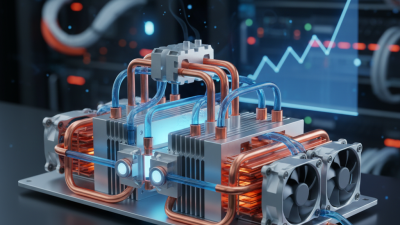
| Aluminum Heat Sink with Fan |
Approximately 35–150 W of heat dissipation, depending on heat-sink size, airflow, and fan speed. |
Approximately 1–6 W for the fan. |
Approximately 20–38 dBA under normal operation. |
Reduces component temperature toward ambient temperature but cannot cool below ambient. |
Compatible with many low- to medium-power electronics when mounting space and airflow are sufficient. |
Low; periodic dust removal and fan inspection are usually sufficient. |
Power supplies, LED drivers, embedded electronics, networking equipment, and moderate-power processors. |
High |
| Copper Heat Pipe Cooler |
Approximately 80–250 W of heat dissipation, depending on the number of heat pipes and fin-stack size. |
Approximately 1–8 W for the fan. |
Approximately 22–40 dBA. |
Provides strong passive heat transfer to a fin stack; final temperature depends heavily on ambient airflow. |
Suitable for compact systems and higher-power processors if the mounting pattern, height, and clearance are compatible. |
Low; requires dust cleaning and occasional fan replacement. |
Desktop computers, workstations, compact industrial controllers, and high-density electronic assemblies. |
High |
| Closed-Loop Liquid Cooler |
Approximately 120–350 W of heat dissipation, depending on radiator size, pump performance, fan speed, and airflow. |
Approximately 5–20 W for the pump and radiator fans. |
Approximately 20–40 dBA; pump noise may be audible at low fan speeds. |
Transfers heat efficiently to a remote radiator, allowing more flexible component placement than a conventional heat sink. |
Requires compatible mounting hardware, radiator space, tubing clearance, and sufficient chassis airflow. |
Low to moderate; radiator cleaning is required, and the pump has a finite service life. |
High-performance processors, dense computing systems, and applications with limited heat-sink clearance. |
Medium–High |
| Open-Loop Liquid Cooling |
Approximately 200–600 W or more when correctly designed with an appropriately sized radiator and pump. |
Approximately 10–40 W for the pump and fans. |
Approximately 18–40 dBA, depending on pump and fan settings. |
Offers strong heat-transfer performance and flexible thermal-system design, but coolant temperature remains linked to ambient conditions. |
Highly configurable; requires compatible water blocks, tubing routes, fittings, reservoir space, and leak-safe installation. |
Moderate to high; coolant inspection, leak checks, flushing, and component maintenance are required. |
Custom workstations, laboratory equipment, high-density computing, and systems with multiple heat sources. |
Medium–High |
| Thermoelectric Cooler (TEC/Peltier) |
Common modules transfer approximately 30–150 W of heat, but performance varies greatly with temperature difference and hot-side cooling. |
Approximately 50–300 W for the module, excluding the hot-side heat sink or liquid loop. |
System-dependent; the TEC itself is silent, but fans or pumps typically produce approximately 20–45 dBA. |
Can cool below ambient temperature when properly controlled, but condensation becomes a significant risk. |
Requires a well-sized hot-side heat sink, power supply, thermal control, insulation, and condensation protection. |
Moderate; requires condensation monitoring, thermal-interface inspection, and control-system validation. |
Optical equipment, sensors, laboratory instruments, and applications requiring precise localized temperature control. |
Low–Medium |
| Evaporative Cooler |
Cooling effect varies with airflow, water evaporation rate, humidity, and available surface area; suitable mainly for air or enclosure cooling. |
Approximately 10–150 W for fans and water pumps, depending on system size. |
Approximately 25–50 dBA. |
Can reduce air temperature toward the wet-bulb temperature, but performance decreases substantially in humid environments. |
Requires water access, drainage or reservoir capacity, humidity control, and protection for moisture-sensitive electronics. |
Moderate; requires water-quality management, pad or media replacement, and cleaning to control mineral buildup. |
Industrial spaces, agricultural environments, outdoor enclosures, and dry-climate ventilation systems. |
High in dry climates |
| Air-Cooled Enclosure or Cabinet System |
Approximately 100–2,000 W of heat removal, depending on airflow rate, filters, heat exchanger design, and ambient conditions. |
Approximately 20–250 W for fans and controls. |
Approximately 35–65 dBA. |
Maintains equipment close to ambient temperature when filtered airflow and heat-exchange capacity are adequate. |
Requires sufficient cabinet volume, intake and exhaust paths, filter access, and compatible environmental ratings. |
Moderate; filters, fans, and airflow paths require scheduled inspection and cleaning. |
Control cabinets, automation equipment, telecommunications enclosures, and industrial electronics. |
Medium–High |
| Refrigeration-Based Chiller |
Approximately 300 W–10 kW or more, depending on compressor size, coolant flow, and condenser capacity. |
Approximately 150 W–5 kW, including compressor, fans, and pump. |
Approximately 45–70 dBA. |
Can maintain coolant below ambient temperature and provide stable temperature control when correctly sized. |
Requires coolant connections, heat-exchanger compatibility, electrical capacity, ventilation, and condensate management. |
Moderate; requires coolant checks, condenser cleaning, pump inspection, and refrigerant-system servicing when necessary. |
Industrial processes, lasers, medical equipment, analytical instruments, and high-precision temperature control. |
Medium |
| Selection note: Cooling capacity and power figures are typical engineering ranges rather than guaranteed ratings. Actual performance depends on ambient temperature, heat-load profile, airflow or coolant flow, thermal-interface quality, installation orientation, humidity, and control settings. Select a cooler with sufficient capacity for the peak heat load and verify mechanical, electrical, environmental, and control-system compatibility before installation. |